Crooked conversation is the art form of our age
And it’s not just politicians anymore
You can’t get an honest answer
And there are no simple facts
And straight forward isn’t either, that’s for sure
You can ask your family doctor
You can call on Madam Rue
You can dial the Psychic Hotline if you choose
You can notify Dear Abbey
You can make the preacher stew
But truth is just a game you’re going to lose
Spin doctored information is the only kind we get
Custom tailored to somebody else’s needs
It’s not the facts that falter
Black and white are still the same
But rumor seldom recognizes deeds
Whatever are we thinking
When we trade the truth for lies?
Was there ever once they really served us well?
We can trace each grand disaster
To the first small damning lie
As we blithely talk our way straight into Hell
Wednesday, October 28, 2009


Friday, October 16, 2009
ONE LITTLE CHANGE
Like most Americans, it often seems to me as if our government is out of control, not because there’s too much or too little of it, but because the people we elect to represent us lose focus. Some scientists say that the human brain is capable of handling 5 to 7 problems at a time. After that, things begin to fall through the cracks. So it’s little wonder that with all the big things going on, it’s the little things (sometimes easily fixable things) that escape attention. Here’s a perfect example.
There’s a very nice lady in my community named Patty, and if you could look up “salt of the earth ” in the dictionary, you’d likely see her picture. Patty holds down a fulltime job, does volunteer work with the elderly in her community, serves on the local auxiliary color guard, and still finds time to join others at the local VFW post in gathering, packaging, and shipping much needed (and much appreciated) care packages to our troops serving overseas. Once again, it’s the little things that can make a huge difference to our service personnel in the Middle East… like lip balm, just for one example!
It turns out that all over America, good folks like Patty are pitching in, with their time, their talents, their money, and their love, so I assumed that the easiest part of this kind of wonderful grassroots charity would be getting the stuff to our troops. But I was wrong. Patty told me that the last time she and her friends assembled a care package and took it to our local Post Office, the bill came to over $350. Ouch!
I read an article in recent years about how much money the United States Postal Service spends on “advertising.” I don’t recall that number, but I think it’s safe to say that it was staggering. And, at that time at least, a large portion of the advertising budget was spent entertaining large, corporate bulk mail users; you know, the multi-million dollar corporations who get all the tax breaks....and all the big discounts on postage.
I say we take a vote on whether non-profit organizations like the VFW should get FREE shipping when they send care packages to our troops!
To vote NO, do nothing at all.
To vote YES, pass this on to everyone you know. (Who knows? It might lead to one little change!)
There’s a very nice lady in my community named Patty, and if you could look up “salt of the earth ” in the dictionary, you’d likely see her picture. Patty holds down a fulltime job, does volunteer work with the elderly in her community, serves on the local auxiliary color guard, and still finds time to join others at the local VFW post in gathering, packaging, and shipping much needed (and much appreciated) care packages to our troops serving overseas. Once again, it’s the little things that can make a huge difference to our service personnel in the Middle East… like lip balm, just for one example!
It turns out that all over America, good folks like Patty are pitching in, with their time, their talents, their money, and their love, so I assumed that the easiest part of this kind of wonderful grassroots charity would be getting the stuff to our troops. But I was wrong. Patty told me that the last time she and her friends assembled a care package and took it to our local Post Office, the bill came to over $350. Ouch!
I read an article in recent years about how much money the United States Postal Service spends on “advertising.” I don’t recall that number, but I think it’s safe to say that it was staggering. And, at that time at least, a large portion of the advertising budget was spent entertaining large, corporate bulk mail users; you know, the multi-million dollar corporations who get all the tax breaks....and all the big discounts on postage.
I say we take a vote on whether non-profit organizations like the VFW should get FREE shipping when they send care packages to our troops!
To vote NO, do nothing at all.
To vote YES, pass this on to everyone you know. (Who knows? It might lead to one little change!)
Friday, October 2, 2009
WIND and PASSION
Being disabled means learning how to adapt, and for over 30 years, as a C6/C7 quadriplegic, I’ve always managed to find a way to do most of the things I wanted to do. I am 58 years old now, and four years ago I was run down in the street by little elderly woman in her white Toyota Corolla. My titanium wheelchair saved my life, but my pelvis is forever shattered, my balance will never be as good as it once was, and my stamina refuses to fully recover. In short, my ability to adapt isn’t as good as it once was, and my spirit’s been flailing accordingly, so what on earth makes me think that I can go back to my childhood passion: sailing?
When I was about eight years old, my mother’s favorite song was called “Red Sails in The Sunset.” She was so inspired by this song, she told my father that she wanted a sailboat with a red sail. Shortly thereafter, an 8 foot plywood pram appeared alongside our dock, complete with a gaff-rigged red sail. (My mother almost always got what she wanted.) As memory serves, she may have actually sailed it two or three times before the novelty wore off. My interest, however, was just winding up, and I asked my dad if I could learn to sail it. “When you can swim across the lake and back without stopping,” he said without missing a beat, “you can sail her whenever you want.”
“I can do that right now!” I said, trying to sound more confident than I felt. He stepped into the rowboat and said “Okay, let’s go.” It was a half mile to the other side of the lake, and as he rowed and I stroked, he began to enumerate the basic parts of a sailboat, explain what they were for, and instruct me in their proper usage. By the time we reached the far side of the lake I had abandoned the crawl and settled into a more comfortable side stroke. My breathing was heavy, but I was exhilarated because I never swam that far without stopping before, and I knew I could make it back to the dock.
What a far cry from today. I’m up at 5:00 a.m. or so, but by 11:00 a.m. I’m ready for a nap! At 8:30 p.m., I’m so bone weary, I can’t wait to hop out of my wheelchair and stretch out for the night. What makes me think I can sail a boat again? I used to be relentless, filled with passion. My determined spirit repeatedly urged my body on when it had nothing left of its severely limited resources to give. But it gave anyway. In the last four years, however, my passion has been slipping away like helium from an old balloon. Each time I call it up, there is less response. Life, the Universe, and Everything seems far less compelling with each passing day, and when calamities rain down upon my friends and loved ones, it weighs on my soul as never before. There has always been pain in the world, but it never felt so personal nor so heavy before. I guess I just got old and tired.
Every summer that little red catboat was my magic carpet, and if there was even the slightest breeze, I was out exploring every inch of that mountain lake. Sometimes I remembered to take a sandwich, but regardless, I seldom came home before darkness and calm had descended around me. I will never forget the night sounds, punctuated by my dipping paddle, as I ghosted back to our dock. I’ll never forget the way it felt.
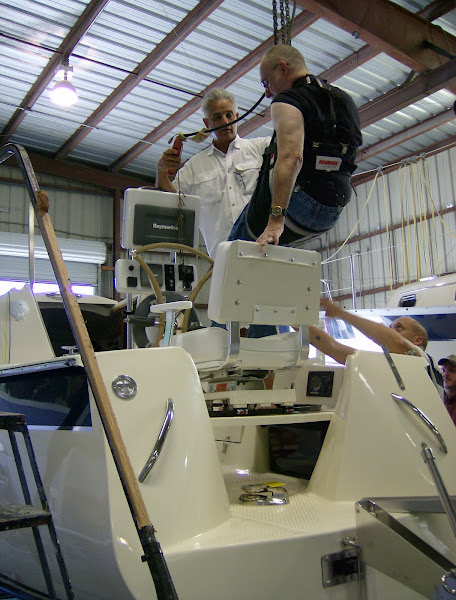
Perhaps I’m trying to recapture those feelings. I don’t know, exactly. But after over a year of research and debate, fraught with self-doubt and stirred by moments of wild hope, I ordered a sailboat. I live in Florida’s middle Keys, where, to the north, the gulf side “back country” runs right up into the Everglades. There are thousands of islands and many more species of wildlife to observe and photograph above and below the crystal clear surface. But it’s shallow. . . sometimes as little as 18” deep in the eddy streams and channels. Just south and east of my little island paradise, the Atlantic stretches across the reef and then the gulfstream to carry a sailor anywhere in the world. And because I wanted a boat that could sail safely in both directions, I settled on a Hake Seaward 26RK.
Right now I can’t say whether my passion for the wind will rise up like the Phoenix of old, or whether I just ordered a very expensive toy for my grandchildren to inherit. All I can do is wait for the factory to call.
When I was about eight years old, my mother’s favorite song was called “Red Sails in The Sunset.” She was so inspired by this song, she told my father that she wanted a sailboat with a red sail. Shortly thereafter, an 8 foot plywood pram appeared alongside our dock, complete with a gaff-rigged red sail. (My mother almost always got what she wanted.) As memory serves, she may have actually sailed it two or three times before the novelty wore off. My interest, however, was just winding up, and I asked my dad if I could learn to sail it. “When you can swim across the lake and back without stopping,” he said without missing a beat, “you can sail her whenever you want.”
“I can do that right now!” I said, trying to sound more confident than I felt. He stepped into the rowboat and said “Okay, let’s go.” It was a half mile to the other side of the lake, and as he rowed and I stroked, he began to enumerate the basic parts of a sailboat, explain what they were for, and instruct me in their proper usage. By the time we reached the far side of the lake I had abandoned the crawl and settled into a more comfortable side stroke. My breathing was heavy, but I was exhilarated because I never swam that far without stopping before, and I knew I could make it back to the dock.
What a far cry from today. I’m up at 5:00 a.m. or so, but by 11:00 a.m. I’m ready for a nap! At 8:30 p.m., I’m so bone weary, I can’t wait to hop out of my wheelchair and stretch out for the night. What makes me think I can sail a boat again? I used to be relentless, filled with passion. My determined spirit repeatedly urged my body on when it had nothing left of its severely limited resources to give. But it gave anyway. In the last four years, however, my passion has been slipping away like helium from an old balloon. Each time I call it up, there is less response. Life, the Universe, and Everything seems far less compelling with each passing day, and when calamities rain down upon my friends and loved ones, it weighs on my soul as never before. There has always been pain in the world, but it never felt so personal nor so heavy before. I guess I just got old and tired.
Every summer that little red catboat was my magic carpet, and if there was even the slightest breeze, I was out exploring every inch of that mountain lake. Sometimes I remembered to take a sandwich, but regardless, I seldom came home before darkness and calm had descended around me. I will never forget the night sounds, punctuated by my dipping paddle, as I ghosted back to our dock. I’ll never forget the way it felt.
Perhaps I’m trying to recapture those feelings. I don’t know, exactly. But after over a year of research and debate, fraught with self-doubt and stirred by moments of wild hope, I ordered a sailboat. I live in Florida’s middle Keys, where, to the north, the gulf side “back country” runs right up into the Everglades. There are thousands of islands and many more species of wildlife to observe and photograph above and below the crystal clear surface. But it’s shallow. . . sometimes as little as 18” deep in the eddy streams and channels. Just south and east of my little island paradise, the Atlantic stretches across the reef and then the gulfstream to carry a sailor anywhere in the world. And because I wanted a boat that could sail safely in both directions, I settled on a Hake Seaward 26RK.
Right now I can’t say whether my passion for the wind will rise up like the Phoenix of old, or whether I just ordered a very expensive toy for my grandchildren to inherit. All I can do is wait for the factory to call.
Monday, September 28, 2009
Words Mean Something
“Words mean something.” The second I heard Rush Limbaugh utter that, I knew I’d have to quote him. . .even if they’re the only worthwhile words I’ve ever heard him say. In an age where “spin” is everything; or, at the very least, almost everything, has some spin on it, we have to listen carefully to the words. Spin is being used to serve specific insurance industry objectives, creating new impressions about legal matters that could ultimately effect your rights, your health, and your life.
I’ve discussed the term “medically necessary” before. It’s one of the earliest phrases created to dramatically decrease the amount of money the insurance companies must spend when you suffer an injury on the job. By getting lawmakers to insert that phrase in the worker’s compensation law of nearly every state, the focus of your “rehabilitation” automatically begins to shift from helping you get back to as worthwhile, healthy, and productive a life as possible, to providing the absolute minimum care necessary to keep you alive from one day to the next. . .with the full knowledge that your life expectancy will drop dramatically as a result.
In our "modern" health care environment, where more and more health care providers are acutely dependent on insurance companies for client referrals and billing completion, we have been hearing our doctors adopt the new language. There have, for example, always been two basic types of severe spinal cord injury: “paraplegia,” paralysis in the two lower extremities, and “quadriplegia,” paralysis in all four extremities. Quadriplegia, because of the far-reaching consequences of having no grip or finger function, has nearly always been considered a “permanent total disability” under most states’ laws. When no way was found to change that legal point of view, insurance companies began referring to quadriplegics as “tetraplegics” if they could raise their arms over their heads. We used to laugh at this because few if any doctors or judges bought into the suggestion that being able to move one’s shoulders was somehow like having one good hand. For twenty four years, no physician would refer to me as a “tetraplegic,” but relentlessness, money, and lobbying eventually paid off.
Some years back, I watched the video taped deposition of the director of a new regional rehab center who, after a ten minute cursory exam, had diagnosed me as a “tetraplegic.” Only when grilled under oath would he admit that, no, I had no practical use of the fingers of either hand. He reluctantly admitted having been an “expert witness” for the same insurance company “several times” before, and he consistently used insurance industry jargon.
Many spinal cord injured folks use a procedure called “intermittent catheterization” to empty their bladders. There are basically two techniques: “sterile” and “clean.” The sterile technique is more expensive; and, in the case of most quadriplegics, requires a trained attendant. But, in most cases, including my own, it helps individuals avoid introducing bacteria into their systems, thus cutting down on the number of urinary tract infections and kidney problems they experience. And kidney problems have traditionally been the number one killer of people with spinal cord injuries. Many individuals who use the “clean” technique do so because they cannot afford the other method. . .or because their insurance company won’t pay for it. When pressed as to why he was recommending that my caregivers be taken away and that I be forced to “self-cath” using the “clean” procedure, this doctor would only repeat the phrase: “It’s less burdensome out in the community.”
What do those words really mean? Less burdensome for whom? Certainly not for me. And are there really that many Americans in my “community” who are OK with Insurance company executive salaries (and bonuses), but want me to be sick more often and die much sooner? I hope not, but watching the news lately certainly gives one pause. In 1977 I received the “Ken Williams Sportsmanship Award,” a beautifully engraved plaque created to honor the memory of one of Orlando’s finest young wheelchair basketball players. I had the great privilege of knowing Kenny, and his wonderful smile and helpful attitude helped me learn how to live and play again despite my injury. Kenny, a poor young black man with no insurance, died in his twenties of kidney failure. He used “clean” technique because he had no choice.
I asked my lawyer: “Would that doctor recommend this for his son or daughter?” His answer was: “Of course not. He would never need to. But he is, what we call in our business, an ‘insurance company whore.’ He says what they pay him to say. If he doesn’t, they send their claimants to another hospital. They have him over a barrel.”
Words mean something. And if we don’t pay attention to what the words mean, whether we need treatment for spinal cord injuries, heart problems, or cancer, we may all be over a barrel before we know it.
I’ve discussed the term “medically necessary” before. It’s one of the earliest phrases created to dramatically decrease the amount of money the insurance companies must spend when you suffer an injury on the job. By getting lawmakers to insert that phrase in the worker’s compensation law of nearly every state, the focus of your “rehabilitation” automatically begins to shift from helping you get back to as worthwhile, healthy, and productive a life as possible, to providing the absolute minimum care necessary to keep you alive from one day to the next. . .with the full knowledge that your life expectancy will drop dramatically as a result.
In our "modern" health care environment, where more and more health care providers are acutely dependent on insurance companies for client referrals and billing completion, we have been hearing our doctors adopt the new language. There have, for example, always been two basic types of severe spinal cord injury: “paraplegia,” paralysis in the two lower extremities, and “quadriplegia,” paralysis in all four extremities. Quadriplegia, because of the far-reaching consequences of having no grip or finger function, has nearly always been considered a “permanent total disability” under most states’ laws. When no way was found to change that legal point of view, insurance companies began referring to quadriplegics as “tetraplegics” if they could raise their arms over their heads. We used to laugh at this because few if any doctors or judges bought into the suggestion that being able to move one’s shoulders was somehow like having one good hand. For twenty four years, no physician would refer to me as a “tetraplegic,” but relentlessness, money, and lobbying eventually paid off.
Some years back, I watched the video taped deposition of the director of a new regional rehab center who, after a ten minute cursory exam, had diagnosed me as a “tetraplegic.” Only when grilled under oath would he admit that, no, I had no practical use of the fingers of either hand. He reluctantly admitted having been an “expert witness” for the same insurance company “several times” before, and he consistently used insurance industry jargon.
Many spinal cord injured folks use a procedure called “intermittent catheterization” to empty their bladders. There are basically two techniques: “sterile” and “clean.” The sterile technique is more expensive; and, in the case of most quadriplegics, requires a trained attendant. But, in most cases, including my own, it helps individuals avoid introducing bacteria into their systems, thus cutting down on the number of urinary tract infections and kidney problems they experience. And kidney problems have traditionally been the number one killer of people with spinal cord injuries. Many individuals who use the “clean” technique do so because they cannot afford the other method. . .or because their insurance company won’t pay for it. When pressed as to why he was recommending that my caregivers be taken away and that I be forced to “self-cath” using the “clean” procedure, this doctor would only repeat the phrase: “It’s less burdensome out in the community.”
What do those words really mean? Less burdensome for whom? Certainly not for me. And are there really that many Americans in my “community” who are OK with Insurance company executive salaries (and bonuses), but want me to be sick more often and die much sooner? I hope not, but watching the news lately certainly gives one pause. In 1977 I received the “Ken Williams Sportsmanship Award,” a beautifully engraved plaque created to honor the memory of one of Orlando’s finest young wheelchair basketball players. I had the great privilege of knowing Kenny, and his wonderful smile and helpful attitude helped me learn how to live and play again despite my injury. Kenny, a poor young black man with no insurance, died in his twenties of kidney failure. He used “clean” technique because he had no choice.
I asked my lawyer: “Would that doctor recommend this for his son or daughter?” His answer was: “Of course not. He would never need to. But he is, what we call in our business, an ‘insurance company whore.’ He says what they pay him to say. If he doesn’t, they send their claimants to another hospital. They have him over a barrel.”
Words mean something. And if we don’t pay attention to what the words mean, whether we need treatment for spinal cord injuries, heart problems, or cancer, we may all be over a barrel before we know it.
Sunday, September 27, 2009
Kicking Back
People who know me well have noticed that I inevitably gravitate toward the nearest wall. My Uncle Al always used to sit with his back toward the wall. "A good cowboy," he assured me, "never sits with his back to the door." I am not a cowboy, and my affinity for walls has nothing to do with bad guys and bar rooms. It's all about kicking back.
Life in a wheelchair isn't as easy as it looks. I know, all we do all day is sit down. How hard can that be? Depending on how high one's level of paralysis is, much of one's day is engaged in the business of keeping one's self upright and in the wheelchair. I am paralyzed from the chest down, for example, and all those lower torso muscle groups which would otherwise provide balance and support have been on vacation since a dock railing broke in 1975. So one hand, at least, is forever busy holding me upright. Unless, of course, I'm kicking back.
My first trip to Craig Spinal Rehabilitation Hospital in Denver was a revelation on many levels. For instance, every wheelchair user at Craig seemed to be cooler than I was, faster than I was, and everybody there was kicking back. Before I could master kicking back, however, I had to learn how to do wheelies, the art of balancing the chair on its rear wheels. Wheelies are helpful when dropping off sidewalks, popping up small curbs, or rolling down steep hills. The side benefit is the fact that when the chair is tipped backwards, gravity holds you in instead of trying to pull you out. In technical terms, it's the L.B.E., or "Lazy Boy Effect." Head back, feet up...where's the remote control? Anyway, once you master the wheelie, you can enjoy kicking back any time you want. All you need is a wall.
I used to think that any wall would do. I was wrong. My first mystery novel was published in 1991. I actually saw it in book form for the first time at the Midwest Mystery Convention in May of that year. It was stacked on one of the booksellers' tables, right there alongside a host of the great mystery authors...Dick Francis, Nancy Pickard, William Kienzle, Elmore Leonard, William Love, et al. I'd died and gone to heaven. I held my book. I fanned the pages ever-so-gently. I even sniffed it. By the time I rolled into an author panel discussion called "Humor in the Mystery" and looked for a place to kick back and enjoy, I felt like I'd finally arrived. Now, all I had to do was get readers to notice.
The only available wall was one of those fold-out partition jobs that hotels use to divide large rooms into not-so-large rooms. I pushed against it to make sure that it was fastened to the floor as well as to the ceiling. Once satisfied that it was, I popped a wheelie, leaned back against the wall, and locked my brakes. Several moments later, I was laughing--along with everyone else--at Nancy Pickard's witty remark about how one recognizes the difference between what is funny, and what is not. A split second after that, I was on the floor in the next room...without my trusty wheelchair.
The wall, as it turned out, felt secure only because a huge banquet table was leaning up against it in the next room. The vibrations caused by my laughter were enough to topple that table, and what several hundred startled people in the first room heard when it fell sounded much like an explosion. What they saw when they turned around en masse left them stunned. A laughing disabled man just disappeared. Right before their eyes. He was leaning up against the wall one second, then the wall swung out like a gigantic pet door, then the strange man was gone. The wall returned and an empty wheelchair lay on its back, its footrests pointing at the ceiling, proof positive that the audience's collective vision had not been a dream. Their dazed silence remained until I butt-scooted back in around the far end of the wall and said: "Now that's funny!" Then they laughed.
Well, 18 years later, I still kick back whenever I can--many wheelchair users do--though I tend to scrutinize each new wall a bit more thoroughly than I used to. Life, the Universe, and Everything is like that.
Life in a wheelchair isn't as easy as it looks. I know, all we do all day is sit down. How hard can that be? Depending on how high one's level of paralysis is, much of one's day is engaged in the business of keeping one's self upright and in the wheelchair. I am paralyzed from the chest down, for example, and all those lower torso muscle groups which would otherwise provide balance and support have been on vacation since a dock railing broke in 1975. So one hand, at least, is forever busy holding me upright. Unless, of course, I'm kicking back.
My first trip to Craig Spinal Rehabilitation Hospital in Denver was a revelation on many levels. For instance, every wheelchair user at Craig seemed to be cooler than I was, faster than I was, and everybody there was kicking back. Before I could master kicking back, however, I had to learn how to do wheelies, the art of balancing the chair on its rear wheels. Wheelies are helpful when dropping off sidewalks, popping up small curbs, or rolling down steep hills. The side benefit is the fact that when the chair is tipped backwards, gravity holds you in instead of trying to pull you out. In technical terms, it's the L.B.E., or "Lazy Boy Effect." Head back, feet up...where's the remote control? Anyway, once you master the wheelie, you can enjoy kicking back any time you want. All you need is a wall.
I used to think that any wall would do. I was wrong. My first mystery novel was published in 1991. I actually saw it in book form for the first time at the Midwest Mystery Convention in May of that year. It was stacked on one of the booksellers' tables, right there alongside a host of the great mystery authors...Dick Francis, Nancy Pickard, William Kienzle, Elmore Leonard, William Love, et al. I'd died and gone to heaven. I held my book. I fanned the pages ever-so-gently. I even sniffed it. By the time I rolled into an author panel discussion called "Humor in the Mystery" and looked for a place to kick back and enjoy, I felt like I'd finally arrived. Now, all I had to do was get readers to notice.
The only available wall was one of those fold-out partition jobs that hotels use to divide large rooms into not-so-large rooms. I pushed against it to make sure that it was fastened to the floor as well as to the ceiling. Once satisfied that it was, I popped a wheelie, leaned back against the wall, and locked my brakes. Several moments later, I was laughing--along with everyone else--at Nancy Pickard's witty remark about how one recognizes the difference between what is funny, and what is not. A split second after that, I was on the floor in the next room...without my trusty wheelchair.
The wall, as it turned out, felt secure only because a huge banquet table was leaning up against it in the next room. The vibrations caused by my laughter were enough to topple that table, and what several hundred startled people in the first room heard when it fell sounded much like an explosion. What they saw when they turned around en masse left them stunned. A laughing disabled man just disappeared. Right before their eyes. He was leaning up against the wall one second, then the wall swung out like a gigantic pet door, then the strange man was gone. The wall returned and an empty wheelchair lay on its back, its footrests pointing at the ceiling, proof positive that the audience's collective vision had not been a dream. Their dazed silence remained until I butt-scooted back in around the far end of the wall and said: "Now that's funny!" Then they laughed.
Well, 18 years later, I still kick back whenever I can--many wheelchair users do--though I tend to scrutinize each new wall a bit more thoroughly than I used to. Life, the Universe, and Everything is like that.
Subscribe to:
Posts (Atom)