Monday, September 24, 2012

God is Bigger


Daily Dose #2
1/10/12

God is Bigger

Those of us who are inclined to believe that there’s an intelligence out in Life, the Universe and Everything that is greater than our own, and that there is a mystical/spiritual aspect to our existence, sometimes tend to frame our “belief” in a way that marginalizes our perception of God.  I call it “God in the box.”  Over the past decade, I’ve been actively trying to let God out of the box by reminding myself that God is bigger…bigger than the myriad religious dogmas, bigger than my mental and emotional limitations, and especially bigger than my fear.

Fear is the opposite of joy according to A Course in Miracles, a very interesting and thought provoking text that I am currently reading.  I’ve also been listening to the lectures of Jacob Glass, a CIM teacher for over 20 years.  Since I believe that having one’s spiritual house in some kind of constructive order should lead to joy, I’ve determined to turn away from everything fear based in my life.  Letting God out of the box I’ve created in order to feel like I’m in control has had an interesting effect on me.  By freeing God up to do whatever it is God does, I seem to have far more energy and time available to attend to the one thing I suspect I’m primarily supposed to be responsible for: me.

So I’m going to try to keep my eyes on my own paper at lot more in 2012, and I’m going to be prospecting for joy…every day.   On the surface of it, seeking joy might sound a little selfish and self-serving, but then how can a fearful person share joy with others?  Fearful people tend to spread fear. 

I think I will spread joy today.

Thursday, September 20, 2012

An Experiment in Positive Daily Intention

Back in January I began a writing/spiritual experiment inspired by Jacob Glass' "Daily Pages." Jacob (a 20+ year teacher/lecturer on A Course in Miracles) has a morning routine in which he creates lists which include items like: "things I got right yesterday," and "things I'm genuinely grateful for." The purpose of this practice is to begin the day in a positive state of mind, setting your vibration and intention for the day ahead. I tried his approach, and it works just like he said it would, but it felt a bit too left-brained for me. I'm a writer, I thrive on narritive, so I modified his concept into my "Daily Doses." As a writing exercise, I am working on being succinct (because I tend to "go on."), so I limit myself to 250-275 words...something easily read in under two minutes.

As a spiritual exercise, I'm just giving myself a "good talking to" each morning, reminding myself of where I've come from, what I've read, and what I've learned about myself, followed by a positive intention for the day...a practical goal that incorporates resisting my "ego-mind," and keeping my overall mindset in a good place. Today's (the day of this blog post) Daily Dose is number 125, so I've kept at it fairly well, and still enjoy it thoroughly on both of its facets. But here's where it all began:

Daily Dose #1
1/9/12

It is My Intention to Keep Changing

I like to think that I’m growing as a human being. At 61, looking back, I’m not thrilled at the pace of my progress, but as Jacob Glass always reminds us, the best stuff, the lasting stuff, is usually accomplished with “penguin steps.” At least I’ve got that method down. So as I contemplate my ever evolving approach to Life, the Universe, and Everything, a major part of my latest plan is to go smaller. At my age, that just keeps getting easier…with everything but my spoken word.

Daily Doses is an attempt to do what I’ve always done (talk about what I think I’m learning), but to do it with two major changes in approach: time and tone. They say timing is everything, but when I get talking about things that mean a great deal to me, I tend to drone on. I forget the time, and just assume everybody will be thrilled to stop what they’re doing and listen to me ramble. As you might guess, this seldom proved to be a correct assumption. So two minutes is my self-imposed time limit for these morning musings. And as far as tone goes, I was always attacking something. Turns out this is a very negative approach and seldom accomplished any of what I had in mind to set right.

So my Doses will be a daily self-help experiment in which I will endeavor to be brief and to the point, all while establishing a positive state of mind with which to approach the day.

Today, I’ve decided, is going to be the best day ever.

Friday, March 4, 2011

What’s the Difference Between a Boater and a Mercury Salesman?

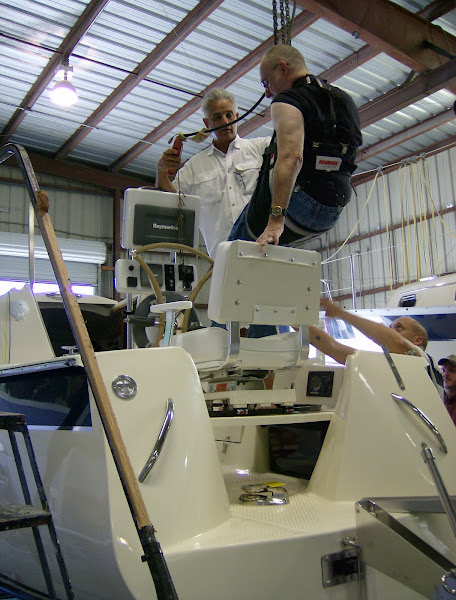
It’s been a long nine months without my new Hake Seaward 26RK sailboat, but the helm seat track—despite being a revolutionary prototype design--was an accident waiting to happen. As a beat-up old quadriplegic (who just turned 60!), I’ve determined to return to sailing after a lifetime away from my favorite pastime. In fact, I set out to see if there was a sailboat designer out there who would be willing to help me create a moderately priced/sized sailboat that nearly anyone—be they old, weak, disabled, or whatever—could sail single-handed. After several prominent companies backpedaled, Nike Hake, at Hake Yachts in Stuart, Florida, stepped right up and said: “we can do this!”

Nick took my initial concepts and either improved them considerably, or came up with something better. In the case of my helm seat track, he did that twice! Among the many challenges for a wheelchair user on a 26’ sailboat was figuring out how to move around the cockpit. Despite the fact that today’s wheelchairs are both stronger and lighter, unless you’re talking about a multi-million dollar mega-boat, using one onboard is out of the question. So Nick Hake designed a curved traveler track that the back of my helm seat attached to via two ordinary cars, he put wheels sideways on the front of the seat, and, like magic, I could ride around the bench from port to starboard and back with relative ease. Simple and ingenious! Well, as it turns out, except when crossing a moderately sized trough.

The first time my open-stern Seaward slipped into a decent trough and shot up the other side, the helm seat’s front wheels rose up off the bench; and, had I not been locked in with the aft stay immediately behind my right shoulder blade, I’m pretty sure I’d have flipped back into the Atlantic, helm seat and all, and I would have found myself fumbling wildly with the Velcro release on my seat belt/shoulder straps….if, that is, if I hadn’t been knocked out on the way into the water! When Nick came down and checked it out, he agreed immediately that we needed a more stable approach.

Nine months later, after dancing furiously with several tubing fabricators, Nick sent the Eleanor P back to the Keys with a new track system worthy of a first rate rollercoaster. The twin tubular rails secure the seat rollers fore and aft, and the only way I’m going in the drink is if I capsize the old girl! So that leads me back to my initial question: “What’s the difference between a boater and a Mercury salesman?” Tim DeVries is the sales manager at Hake, and even years after a sale, he takes his customers more seriously than any salesman I’ve ever met. Instead of sending a couple guys down, he came himself, and as it turns out, he and his assistant, Rob, had to rig and launch the Eleanor P at the nearby Hawk’s Cay Resort, in gusty 25-30 mph winds.

The Mercury engine folks come to the famous Florida Keys resort every year for a company to-do, and they had a couple of in-service tents set up next to the boat ramp, so there were usually a half dozen or more sales types coming and going, sitting around drinking coffee, and gawking at Tim and Rob as they struggled to raise the rigging in the mini-gale. At one point, as Rob strained to lock in the mast foot and connect the wiring, Tim, on tip-toes, was pushing against the swaying mast crutch with all his might. (I should admit, at this point, that by adding a solar panel above the cockpit, and Gerry-rigging a new, higher mast crutch assembly, I had inadvertently made his job much more difficult.) If Tim slipped, and my mast crutch snapped or bent in the wind, my solar panel would be toast, so I rolled over behind the trailer where the aft stay hung down on the ground and scooped it up onto my lap. I backed my wheelchair awkwardly into the wind, locked the brakes, and wrapped the stay cable around both my gimpy arms in an effort to take some of the pressure off Tim. Twenty feet away, in the shade of their tents, team Mercury watched with great interest…but not one of them made the slightest move toward pitching in. By the time Rob began hoisting the mast, my gimpy hands were numb-er than usual, and I was very glad to release the stay.

A few minutes later, Tim was backing down the boat ramp, and I was giving Rob directions to my slip. One piloting mistake coming off the inaccessible loading dock, or one stall-out by the 15 hp Yanmar which hadn’t run in nine months, and the Eleanor P would be dashed on the rocks by the relentless wind and waves. I couldn’t do anything to help, so as Rob took the helm, Tim tried to design a combination of docking line maneuvers to at least help turn the little sloop into the wind before he had to let go of the lines. Once again, and now a mere ten feet away, the Mercury sales guys sipped their coffee and stared. I couldn’t help wondering if it was because I had a Yanmar, not a Mercury, engine. There seemed no good way to launch, until a 75-year-old guest at the resort, a man who’d stopped by on his way to the marina store to admire the boat earlier, returned. He took one look at the scene, hurried out onto the dock, and took one of the lines from Tim. Like the three of us, he was a boater, had been since he was a kid.

Well, I’ve finally got my boat back, Tim and Rob are safely back in Stuart, and that old man said he’d be anxiously waiting to hear whether his bid was enough to buy a forty-something foot Island Packard. I’m sending out good vibes for him…which is more than I can say for the folks at Mercury. We crazy old sailors have to stick together, and like it or not, everybody needs an extra hand now and then.

Monday, March 29, 2010

Easy Owner Modification


Those of us with daysailers and/or weekenders browse the sailing magazines and boat shows with no small amount of envy. To have a real chart table, or a "nav station," well, that's just a pleasant dream. But in the meantime, we do the best that we can with what we have.

Like those on most small sailboats, our Seaward 26RK's table is small and it stows away neatly, but I couldn't figure out where to put my laptop everytime we need the table for something else. So, with a few scraps of 1" x 2" cedar, some 1/4" plywood, a couple of hinges, some 1/2" insulating foam, a piece of fishing line and a little stain, I built a simple "table-topper." Non-skid shelf covering, double-face taped to the table, keeps the computer from sliding around, and when the table is stowed, the lid is held firmly closed by the cabin headliner.

Overall construction is waterproof wood glue, and I drilled holes and glued in dowelling instead of using screws to secure the plywood to the cedar framing. We used a jigsaw to round off the square corners after the glued-in support wedges dried in place. We seldom create a custom wood shop look in our little garage bay, but those of us with physical disabilities, steeped in art of adaptation, generally lean toward function over form. This little modification functions quite well.

Monday, March 15, 2010

No Bananas Aboard

I recently finished reading Morgan’s Run, another great historic novel with sailboats aplenty. The myths and the superstitions surrounding seafarers are myriad, and it’s often hard to sort out those with true historical basis, from those spawned of alcohol consumption alone. Sometimes it just doesn’t matter . . . like this morning when my neighbor, Sandy, told me matter-of-factly that my friend, Gene, was a banana.

My prop-fouling disaster happened 50 yards off Sandy’s dock the other day, and I was telling her the story while she soaked my feet in salty water and ran an electrical current through the brine. (Ellie pays Sandy to do this to me, but I haven’t gotten up the courage to ask why. I just smile, try not to touch anything made of metal, and say “Thank you.”)

“Real sailors never take bananas on board ship,” she said earnestly, “and it sounds to me like Gene’s a banana.” I didn’t know which question to ask first, but fortunately I didn’t have to. Sandy went on: “Something about bugs or disease, I think, but maybe just really bad luck. Anyway, some people are definitely bananas, and you just can’t let them get on your boat. Gene’s definitely a banana.”

Well, that was that. You learn something new every day . . . and any day I leave Sandy’s without being electrocuted is a good day. I haven’t yet gotten around to telling Gene to stay in Miami if he wants to go boating again, but stranger things have happened. He did sink his buddy’s motorboat in Biscayne Bay a short while back, with eight hands on deck. He swore they were swamped by a passing cruise ship, but who’s to say that there weren’t bananas involved? (Or, at the very least, banana daiquiris?) According to Gene, there was a reality TV show film crew on the bay that day; apparently they filmed the sinking and interviewed all the wet folks. Gene says it’s going to be the season opener.

At my age, hindsight is 50/50, but I think, way back when we first met, Gene told me he was in a 911 type reality show once before, when he was a teenager, something about a swimming buddy breaking his neck while they were at the lake together. He said you can still find it on YouTube. I’m not saying Sandy’s right or anything, but Gene was at the wheel when my prop fouled the other day. In fact, he was blocking my view of the excess portside jib line all morning. No, I’m being silly. It was just an accident, that’s all. Accidents happen. (But why have I been hearing Jimmy Durante singing “Yes, we’ll have no bananas” in my head all day?)

Gotcha! Sounds

The world is full of gotcha! sounds. Every new (to you) house, car, motorcycle, power tool, and, yes, sailboat makes them. These intrusive noises are seldom harbingers of good news, and are almost always sorted out by accident. That is, nobody tells you in advance: “Mr. Foster, if you ever hear a loud CLANG, followed immediately by a metallic scraping noise and a shower of sparks, it probably means someone should have replaced those driveshaft bearings. Enjoy your hardly used Chevrolet!” Nope, it never happens like that; rather, you’re more likely to be driving along a winding, narrow, cliff-side road overlooking the Ohio River just outside Pittsburgh.

But I digress. My new sailboat’s first Gotcha! sound was actually nothing bad. Just a loud “thunk” when the retractable keel winch cable slips off an adjacent cable wrap just before I reach the “all up” position. Scary, but the boat’s designer assures me it’s nothing bad. Phew! Today’s Gotcha! sound, was also a “thunk,” but it was way louder, and followed by a pulse-stopping, metal-grinding, part-snarling moan. This terrible thunk/moan shut my 14HP diesel down, and even with my boundless lack of experience and/or expertise, I knew this sound couldn’t be as benign as its predecessor. We were dead in the water, a couple blocks from our neighbor’s dock, and drifting the wrong way. Thankfully, the massive ketch usually tied to the approaching pylons was on its way to the Panama Canal, so I assumed the owner wouldn’t mind if we tied off to ponder Life, the Universe, and Everything while we waited for a tow.

My first instinct upon hearing today’s Gotcha! sound had been to glance at the depth finder. I’ve now logged enough hours practicing motoring maneuvers in Lake Louise to not only have created layers upon layers of chart plotter etcha-sketch lines any kindergartener would be proud of, but also to know that I’d never seen a depth reading under ten and a half feet. But I had to look. Eleven feet deep . . . we didn’t hit bottom.

I couldn’t bear the thought that my brand new transmission had conked out, but since there wasn’t a lobster pot anywhere near Lake Louise, I was hard pressed to sort out the puzzle . . . until my roving eye passed around the deck for the hundredth time. Why did the self-tailing tang on my port jib winch look bent? And worse, why was the red line headed over the port rail instead of being tied neatly to the stern rails like its starboard twin? GOTCHA!

OK, bad stuff happens, and sailboat lines, like sound reinforcement cables, are the blessing and the bane of Life, the Universe, and Everything. They are like wayward children, prone to sneak off the reservation at the slightest provocation, and until I get someone to cut the last bit of line off my prop, I’ll not know the extent of the damage. Who said "bad luck is better than no luck at all?" I'd like a word with them……

Sunday, March 7, 2010

Fits and Starts


This business of getting a 59-year-old quadriplegic back into sailing is far more complicated and time consuming an endeavor than any sane gimp might want to embark upon, but that’s what adaptation is all about: living and enjoying life . . . even if getting at the heart of it is usually more difficult. My new Seaward 26RK was delivered on the 18th of January, in the midst of the coldest, longest, stretch of real winter anybody in the Florida Keys can remember. Day after day, the highs have been in the 50’s/60’s, and the lows have been in the 40’s on far too many nights. Here in the tropics, where the average daily temp is 82, that’s a serious challenge to any local, let alone an arthritic old geezer like me, but that’s just one of many reasons I’ve had nothing to blog about ‘till now.

Fortunately, we got a lot accomplished in the past month or so, even if practicing our seapersonship wasn’t included in the list. The big deal was electrical independence. Since my dream has been to explore the Keys at my leisure, and since I suspected that I’d need to stop and rest more often than most, I wanted to be able to crank up the microwave and the laptop whenever I wished . . . without having to crank up the 14hp Yanmar diesel inboard to keep the batteries up. I planned on having a solar panel from the beginning, but it didn’t take much to talk me into adding a wind generator too. While they were at it, I had them double my battery banks, add a more detailed battery monitor and a DC “cigarette plug” outlet, and move a few electrical items to more accessible locations. “Up ‘till now,” said Mike the electrician from S.A.L.T. in Marathon, “this has been Hake’s boat. My job is to help you make it your boat.” And when he finished, Mike presented us with a complete electrical schematic of our boat!

The other issue keeping us on the shore has been dock height. Here on the ocean side, tides range two to three feet, and our neighbor’s seawall (they’ve been graciously letting us dock there!) is meant more for luxury yachts than for little daysailers like ours, so in order for my boom hoist to lift me out of my wheelchair, the tide needs to be up, along with the boat’s topping lift. We used a block and a couple of cable clamps to move Nick Hake’s adjustable topping lift device another 18 inches up the topping line (Nick offered us a shorter topping line, but that meant bringing the mast down or sending Ellie up in my bosun’s chair, so we respectfully declined!), so now we can crank the boom high enough to function on this (or almost any?) dock, but the more severe boom angle makes the swing onboard and off a bit more precarious. It’s nothing Ellie and I can’t handle, but I don’t think I could manage it alone. So we’ve located a marina on the gulfside, and secured a slip where the dock is almost two feet lower, and the tide range is halved . . . easier for everyone. Our next outing will be the 22-mile trip up through Channel #5, under the Long Key bridge, and back down on the other side.

Yesterday, even the tide and the cold winds couldn’t keep us off the Eleanor P, and so we loaded up and went to work on the most basic skill set necessary to turn us into sailors . . . motoring. It sounds strange, but learning how to handle your boat at or near the dock is where most newbies fail to do their homework. The result is a lot of damage to boats, docks, and people. We’ve watched some of the movie and YouTube boat crashing scenes and don’t want to add our clip to that particular wall of shame, so we spent two hours practicing on Lake Louise in forward, and in reverse, and doing dock approaches. I am so glad I spent a small fortune on bow thrusters, but I’m still going to need way more practice before I can bring the Eleanor P in alone. Thankfully, yesterday’s outing taught me that I will be able to do it eventually.

Before quitting for the day, and even though the cold wind was doing a number on my neck and shoulders, I just had to go out to sea. I’ve never skippered a boat in the ocean before. I have countless hours in the Intracoastal Waterway, thanks to my time in the crabbing business up in central Florida, but aside from being a passenger on cruise ships and party fishing boats, I’ve never taken the helm and gone to sea. As the Eleanor P slipped out of the causeway, though Hawk’s Channel, and out into open water, it was nearly impossible not to raise the sail, and had I not been cold to the bone, I probably would have done it. Next time, for sure!